No. DoorDash does not pay for gas or reimburse mileage; its help center lists fuel among the vehicle costs it won’t cover. The offer amount is all you get for the trip, so it has to pay for your gas, wear and tear and taxes. You can lower your tax bill by deducting business miles, and DoorDash’s Crimson debit card gives some cash back on gas.
Does DoorDash reimburse gas or mileage?
No. DoorDash’s reimbursement FAQ says that under the contractor agreement you decide how to deliver, and it won’t reimburse motor vehicle expenses such as insurance, registration, fuel and servicing. It also won’t pay for your phone and internet, tolls, parking fees or tickets.
What it does reimburse is order costs you pay yourself, for example when your Red Card is declined or a store is cash only, with an itemized receipt. That is a refund for the order, not a fuel payment.
In 2026 DoorDash ran a temporary gas relief program: weekly payments for Dashers who drove 125 miles or more on deliveries, which ran until April 26, 2026, and 10% cash back on gas with the Crimson card, extended to June 30, 2026. Both have ended, so check the Dasher app for any new offer.
Gas cash back with the DoorDash Crimson card
DoorDash Crimson is a Visa debit card for your Dasher earnings, issued by Starion Bank. DoorDash says it gives cash back on gas when you pay at the pump, and on EV charging, on up to $600 of spending per calendar month. In its March 2026 announcement, DoorDash described the standard gas rate as 2%.
Rewards collect in a separate balance that you move over by tapping Redeem to balance in the Crimson Hub on the Earnings tab. DoorDash says the rewards can change without notice, so check the current rate in the app. At 2%, $50 of gas earns $1 back: useful, but not a reimbursement.
How offer pay has to cover gas
In Earn per Offer mode, DoorDash says base pay ranges from $2 to $10 or more and depends on the estimated time, distance and desirability of the offer. Distance is estimated from your current location, and there is no separate fuel or mileage line. The amount on the offer screen is the minimum you’ll earn for that offer.
So the miles back to a busy area, or home, come out of the same payout. Earn by Time pays a guaranteed hourly rate for active time plus tips and promotions, and DoorDash’s description of it doesn’t include a mileage or gas payment either.
California is different. Under Proposition 22, DoorDash says California Dashers earn at least 120% of the local minimum wage for active time plus $0.37 per mile during active time in a motor vehicle, the 2026 rate published by the State Treasurer. Active time runs from accepting an offer to completing it, and DoorDash adds an adjustment only when your pay falls below that floor.
Work out your own cost per mile
To know whether an offer covers your gas, work out what a mile costs you. Divide the price of a gallon by your car’s miles per gallon to get fuel cost per mile. Then add maintenance: total last year’s spending on oil changes, tires and repairs, and divide it by the miles you drove.
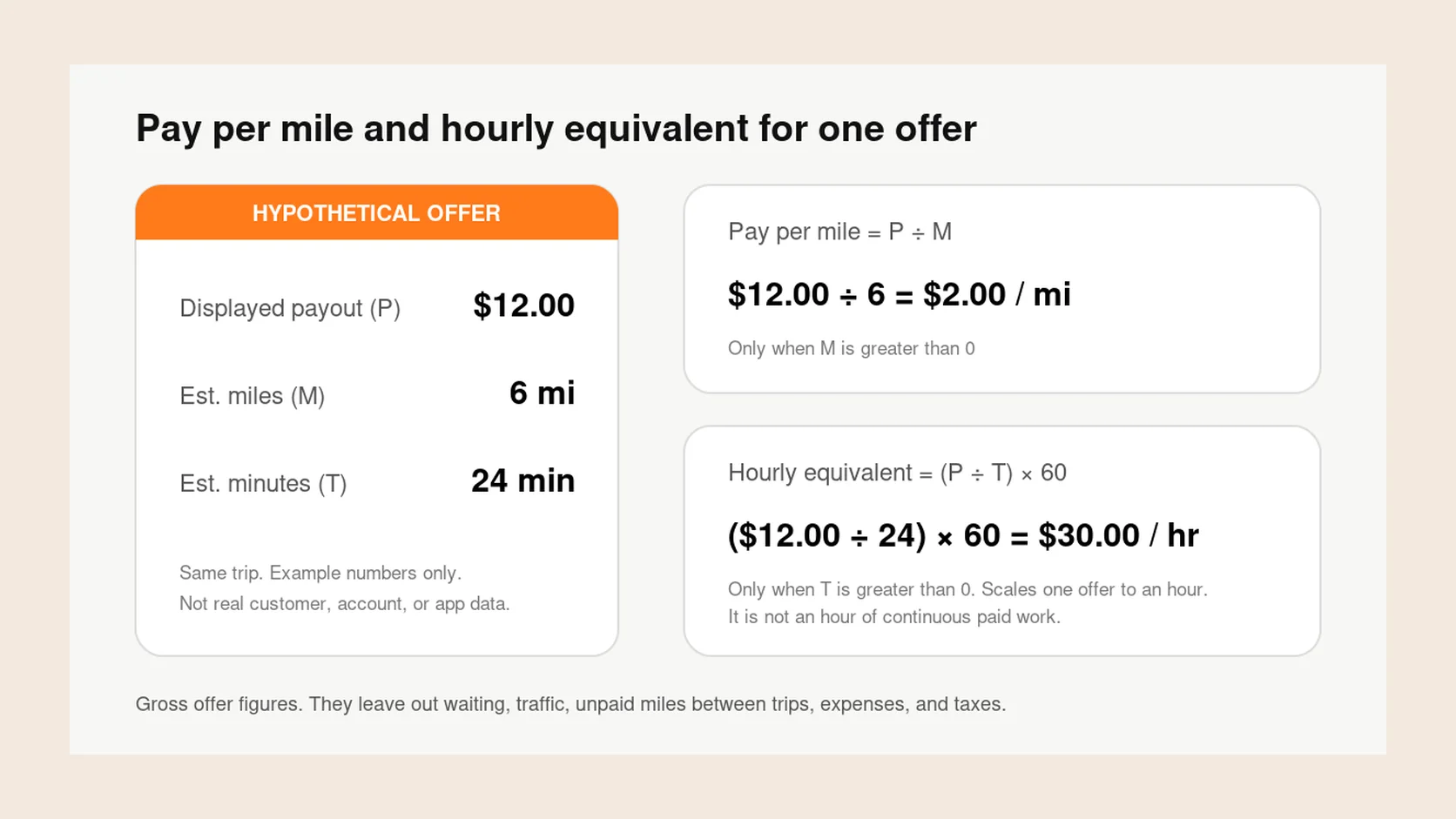
The table uses a gas price of $3.50 and $0.10 a mile for maintenance for three hypothetical cars. Your own fill-ups and repair receipts are better than any average. To work out the offer side, see how to calculate pay per mile and hour.
This running cost leaves out insurance, registration and the value your car loses with each mile. That is why it’s much lower than the IRS rate in the next section.
| Detail | Car A: 25 mpg | Car B: 35 mpg | Hybrid: 50 mpg |
|---|---|---|---|
| Fuel per mile at $3.50 a gallon | $0.14 | $0.10 | $0.07 |
| Maintenance and tires per mile | $0.10 | $0.10 | $0.10 |
| Running cost per mile | $0.24 | $0.20 | $0.17 |
| Cost of a 10-mile offer, including the drive back | $2.40 | $2.00 | $1.70 |
| Left from a $9 payout, before taxes | $6.60 | $7.00 | $7.30 |
The 2026 IRS mileage rate: standard mileage or actual expenses
For taxes, self-employed drivers can deduct business miles at the IRS standard mileage rate. For 2026 it is 72.5 cents per mile from January 1 to June 30 and 76 cents per mile from July 1 to December 31. The IRS raised it mid-year because of higher fuel prices (Announcement 2026-11).
The rate is based on an annual study of the fixed and variable costs of running a car, so it already covers gas; you use it instead of your actual car costs. Parking and tolls on business trips are deductible separately either way. For example, 4,000 business miles in the first half and 5,000 in the second half would be $2,900 plus $3,800, a $6,700 deduction (hypothetical numbers). A deduction lowers your taxable profit; it isn’t money paid to you.
The other choice is actual expenses: gas, oil, repairs, tires, insurance, registration and depreciation or lease payments, multiplied by your business share of miles. If you own the car and want the standard rate, you must use it in the first year the car is used for business; with a lease, you must keep it for the whole lease. This is general information, not tax advice, so ask a tax professional which method suits you.
Which miles count, and how to keep a mileage log
Miles driven to pickups and to customers are business miles. Miles while you’re online and moving between work areas may count too, but the drive from home to your first pickup can fall under commuting rules that depend on your situation. Personal errands don’t count, even with the app on.
The IRS asks for the miles for each business use, your total miles for the year, and the date, place and purpose of each trip, recorded at or near the time. A weekly log counts as timely, and a record kept on a computer or phone is fine. DoorDash emails car Dashers an estimate of on-delivery mileage by January 31, but that is only part of your driving, so keep your own log.
Record your odometer at the start and end of the year
The IRS wants total miles for the year as well as business miles, so write down the reading on January 1 and December 31.
Open an entry when you go online
While parked, note the date, the starting reading and the apps you’re working in.
Close it when you go offline
Record the ending reading and the miles driven, and note any personal stops so you can take them out.
Keep receipts
Save parking and toll receipts. If you might use actual expenses, keep every receipt for gas, repairs and insurance too.
Back it up every week
A notebook, spreadsheet or mileage app all work. Keep the records for at least three years after you file.
Do delivery drivers get paid for gas? What about Uber Eats?
Most app-based delivery drivers aren’t paid for gas separately, because they’re contractors who cover their own costs. Uber says Uber Eats upfront fares factor in the estimated time and distance to complete a delivery, and it doesn’t describe a separate gas or mileage payment. The same cost-per-mile math applies to Grubhub and Instacart, and you can check any offer with the free offer calculator.
Uber does offer gas savings through its tier programs. The Uber Pro Card gives 2% to 6% cash back on gas at the pump depending on your tier, when you choose Credit or bypass the PIN. From October 5, 2026, Uber also raised its Upside offer to up to $1.00 cash back per gallon and its Shell offer to up to $0.21 off per gallon, by tier, for a limited time.
Some places set minimum pay that includes a per-mile amount: $0.37 per engaged mile under California’s Prop 22, and $0.80 per engaged mile in Seattle’s 2026 minimum for covered app-based workers. These are pay floors for time on an offer, not refunds for gas you buy. If you deliver as an employee of a restaurant or store, ask your employer about its mileage policy.
Once you know your cost per mile, compare it with each offer’s pay per mile before you accept. Giga Driver shows pay per mile and per hour on DoorDash, Uber Eats, Uber and Lyft offers and grades them against trip goals you set. You still accept or decline in the app yourself.
Key takeaways
- DoorDash doesn’t reimburse gas, mileage, tolls or parking; the offer amount has to cover them.
- The DoorDash Crimson card gives cash back on gas at the pump, and the 2026 relief offers have ended.
- Your running cost per mile is fuel price divided by mpg, plus maintenance per mile.
- The 2026 IRS rate is 72.5 cents per mile for January to June and 76 cents from July 1.
- Keep a mileage log made at the time; DoorDash’s year-end estimate covers only on-delivery miles.
Common questions
Does DoorDash pay mileage?
Not as a separate payment. Distance is one factor in base pay, and in California Prop 22 adds a per-mile amount to the earnings floor for active time. Outside those rules, there is no per-mile reimbursement.
Can I deduct gas if I use the standard mileage rate?
No. The standard rate already covers gas, oil and other running costs, so you choose it or actual expenses, not both. Parking and tolls on business trips are the exception and can be added either way.
What if DoorDash’s mileage estimate is lower than my log?
That can happen, because DoorDash’s estimate covers on-delivery mileage only. For taxes, use your own log of business miles, made at the time. Keep it with your receipts in case the IRS asks.
Is DoorDash worth it with gas prices?
It depends on your car and the offers in your area. Work out your cost per mile, then compare it with what each offer pays per mile, including the drive back. See is DoorDash worth it for the full picture.
Does a hybrid or EV make a big difference?
It cuts the fuel part of your cost per mile, as the hypothetical table shows, but maintenance, insurance and the car’s loss in value still apply. The Crimson card also gives cash back on EV charging, so check its current terms.