Uber pays drivers per trip, not per hour, so what you make depends on your fares, tips and promotions, how long you wait between rides, and what your car costs to run. The latest national figure on Uber’s newsroom is a median of $33 per utilized hour for late 2023, counting only time on trips and before your costs. Here’s how each fare is built, which local rules set a minimum, and how to work out your own hourly pay.
How Uber pays drivers for each ride
In most US cities, Uber shows an upfront fare on the request, so you see what you’ll earn and roughly where you’re going before you accept. Uber says the fare is based on a base amount, the estimated time and distance, the drive to the pickup, and surge when it’s active. Some cities pay per minute and per mile at the end of the trip instead.
Uber adds pay if a trip runs more than 5 minutes past its estimate, pays wait time after 2 minutes at most pickups, passes tolls through to you, and pays a fee when a rider cancels late. Uber keeps the difference between what the rider pays and what you earn, not counting tips, tolls and some fees, and says that share changes by trip and by week.
Surge, Quest, Boost+ and tips
Extras change by city and by week, so check what your Driver app offers today rather than counting on last week’s promotion.
- Surge: trips that start in a purple area on the map while surge is on include extra earnings in the fare.
- Boost+: occasional extra pay for trips that start in a set area during a set time.
- Quest: a bonus for finishing a set number of trips in a set period. One trip short means no bonus.
- Tips: Uber says they’re yours, with no service fee taken. They arrive after the trip; see Do Uber drivers see tips?
What Uber publishes about driver pay
In an April 2024 newsroom post, Uber said median US driver earnings were $33 per utilized hour in the fourth quarter of 2023. Utilized time is time active on a trip, so waiting between requests is left out. The post doesn’t say whether tips are counted, and the figure is before gas, maintenance, insurance and taxes.
Uber’s city sign-up pages show a recent four-week median per hour. The New York City page showed $37.27 for September 28 to October 26, 2026, including fares, certain promotions and tips, without saying whether the hour means time online or on trips, and without subtracting costs. New York also has a minimum pay rule, so its figure doesn’t carry over to other cities.
Why online hours and utilized hours give different answers
Utilized hours count only time on trips. Online hours count everything from going online to going offline, including waiting, driving to a busier area and empty drives back. Your time and your car cost money in every online hour, so use online hours for your own pay.
Say you earn $100 with 4 hours online and 2.5 hours on trips. That’s $40 per utilized hour but $25 per online hour, from the same hypothetical $100 before costs. Miles work the same way: the fare counts the drive to the pickup, not the miles between rides, so log every mile from the moment you go online.
City and state rules that set a minimum
A few places set a floor under rideshare pay. These rules mostly cover time and miles with a passenger, or from accepting a trip to drop-off, so waiting still isn’t paid. Most states have no rideshare minimum.
- New York City: since March 1, 2026, the per-trip minimum for app-based rides is $1.283 per mile plus $0.681 per minute, with more for wheelchair-accessible and out-of-town trips.
- Seattle: in 2026, at least $0.70 per minute plus $1.63 per mile, or $6.12 per trip if that’s more. Elsewhere in Washington it’s $0.40 per minute plus $1.38 per mile, or $3.55. Tips are extra.
- Minnesota: since December 1, 2024, at least $1.28 per mile and $0.31 per minute with a passenger, and $5 per ride, rising with inflation from January 2027.
- California: Prop 22 guarantees 120% of the local minimum wage for active time plus $0.37 per active mile in 2026, checked every two weeks, with tips not counted (Uber’s guarantee page).
- Massachusetts: after a 2024 settlement with the attorney general, Uber guarantees $34.48 per hour of active time, checked over two weeks, before tips (Uber’s Massachusetts page).
Work out your own pay per hour after costs
The number that matters is what you keep for each hour online. The table works through one hypothetical shift, and the steps below show how to do the same with your own records.
| Item | Amount |
|---|---|
| Time online | 5 hours |
| Time on trips | 3.5 hours |
| Trips | 10 |
| Fares, tips and Quest bonus | $118 + $14 + $10 |
| Total earnings | $142 |
| Miles driven while online | 110 |
| Car costs at $0.30 per mile | $33 |
| Total per trip | $14.20 |
| Total per utilized hour | $40.57 |
| Total per online hour | $28.40 |
| After car costs, per online hour | $21.80 |
Time the whole shift
Note when you go online and when you go offline for the last time. If a second app was on at the same time, count those minutes once.
Split your earnings
From the weekly statement in the Earnings section, list fares, tips and promotions separately, so you can see how much depends on extras.
Log and price your miles
Read the odometer at the start and end. For fuel, divide your gas price by your miles per gallon, then add an amount per mile for tires, oil, brakes and lost value.
Divide by online hours
Subtract costs from earnings and divide by hours online. That’s your pay before income tax and self-employment tax, which [our gig driver tax guide](/guides/does-doordash-take-out-taxes) explains.
Check each ride before you accept
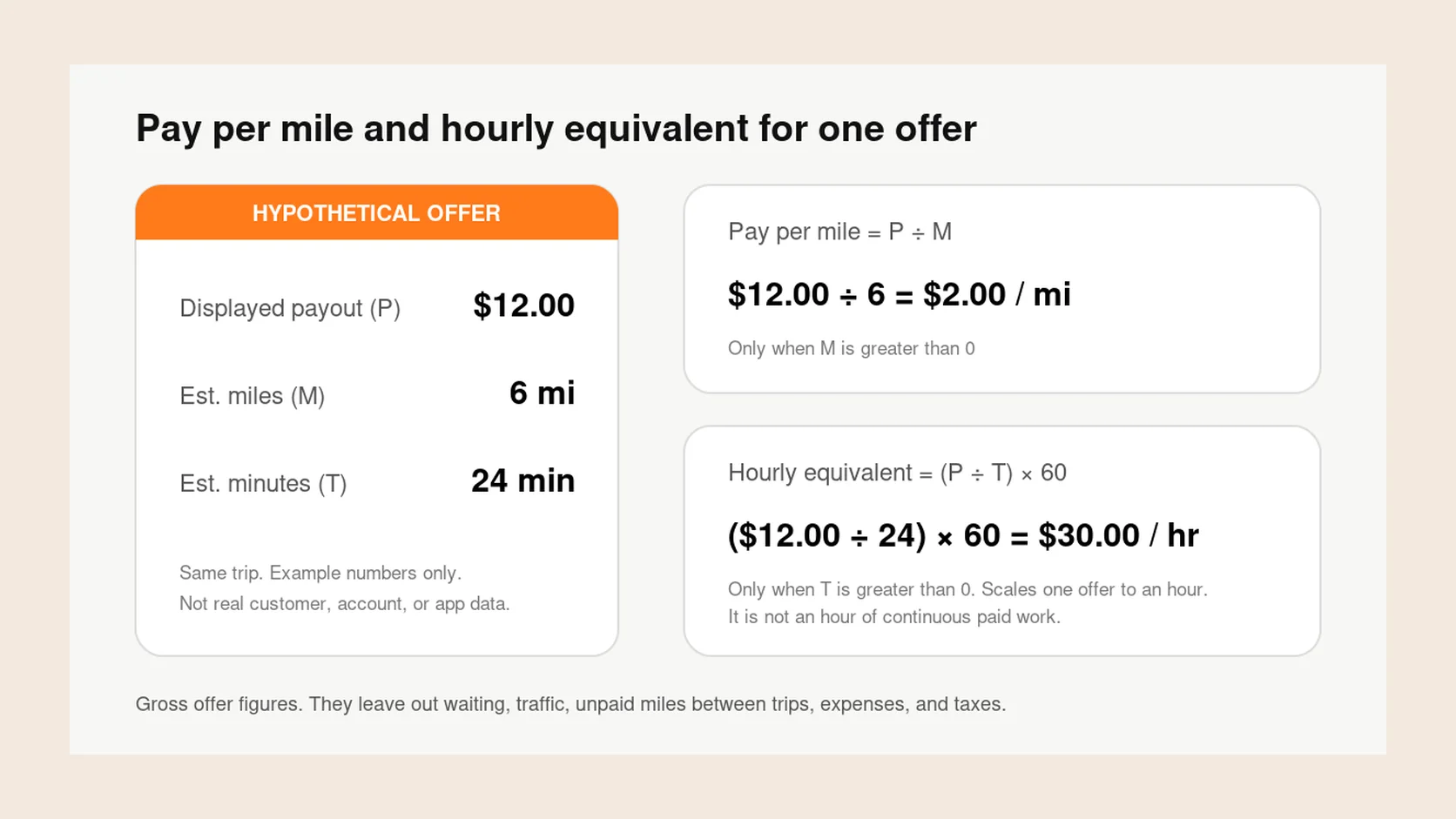
When a request comes in, compare the fare with the total miles and minutes, pickup included, and pass on the ones below your minimum. The free Grade your offer calculator shows pay per mile and per hour for any offer, and How to calculate pay per mile and hour walks through the math.
If you’d rather not do this math on every request, Giga Driver shows pay per mile and per hour on each Uber and Lyft ride offer and grades it against the goals you set. You still accept or decline in the Uber Driver app yourself, and the offer history lets you review what you were offered.
Key takeaways
- Uber pays per trip, not per hour, and in most cities shows the fare before you accept.
- Surge, Boost+ and Quest change by city and week, and tips arrive after the trip.
- Uber’s newsroom median of $33 per utilized hour for late 2023 leaves out waiting time and costs.
- New York City, Washington state, Minnesota, California and Massachusetts set pay floors, mostly for time with a passenger.
- Your real number is earnings minus car costs, divided by every hour you were online.
Common questions
Do Uber drivers get paid hourly?
No. Uber pays per trip, plus tips and promotions, and time spent waiting for a request isn’t paid. In California and Massachusetts, Uber tops up your pay if earnings for active or engaged time over two weeks fall below the local floor, but that’s a guarantee, not an hourly wage.
How much do Uber drivers make per ride?
It depends on trip length, pickup distance and surge, and in most cities you see the fare before accepting. For your own average, divide a week’s fares by your trips, then repeat with tips and bonuses included. In the hypothetical shift above, that’s $11.80 in fares and $14.20 in total per trip.
How much do Uber drivers make a year?
Uber doesn’t publish an annual figure. Multiply your after-cost pay per online hour by the hours you expect to drive, leaving out weeks off. The yearly total on your Uber tax summary is gross pay, so it will be higher than what you kept.
How much do Uber drivers make in California?
California has the Prop 22 floor: 120% of the local minimum wage for active time plus $0.37 per active mile in 2026. The state minimum wage is $16.90 an hour in 2026, and cities with a higher local minimum, such as San Francisco, have a higher floor. Time waiting for a request isn’t covered.
What is the best time to drive Uber?
Uber’s heat map shows areas where estimated hourly earnings are above the citywide median, based on fares, tips, promotions and surge. Many drivers start with weekday commutes, Friday and Saturday nights, and airport arrival peaks, but busy times differ by city. Try a few shifts and compare your after-cost pay per online hour.