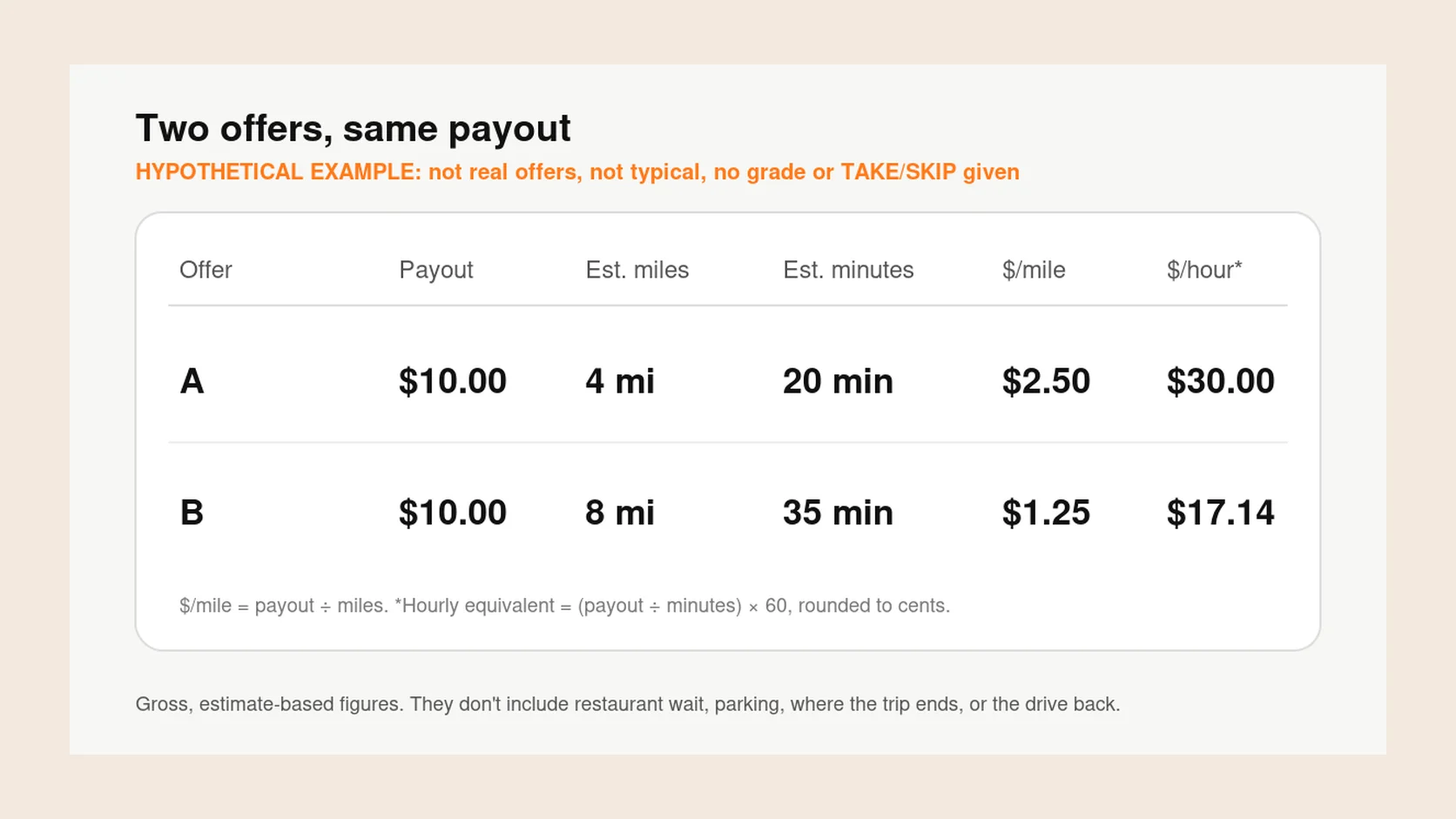
To make more money on DoorDash without adding hours, raise what each hour pays: set your own minimum pay per mile and per hour, judge the whole trip before you accept, and dash when and where orders come steadily. Then check your results after each shift and adjust. None of this guarantees a number, but each habit cuts some unpaid time or miles.
Set your own minimums before you go online
The quickest way to raise your hourly pay is to stop taking offers that pull it down. Before your shift, pick two numbers: the least you’ll accept per mile and as an hourly equivalent. Base them on your own vehicle costs, not on someone else’s screenshot.
Pay per mile is the payout divided by the miles. The hourly equivalent is the payout divided by the minutes, times 60. As a hypothetical example, a $9 offer over 4 miles and 20 minutes works out to $2.25 per mile and $27 an hour. The full method is in How to calculate pay per mile and hour.
DoorDash says the amount on an offer is the minimum guaranteed pay for it, and that base pay in Earn per Offer mode ranges from $2 to $10 or more depending on estimated time, distance and desirability. Your minimums tell you whether that’s enough.
Judge the whole trip, not just the payout
A payout tells you what an offer pays, not how long it keeps you. Before you accept, look at the drive to the restaurant, how long that restaurant usually takes, and where the drop-off leaves you. A drop-off at the edge of your zone often means an unpaid drive back.
In the hypothetical comparison below, the bigger payout is the weaker offer once the drive back is counted. Add your own estimate of the return miles and minutes, and keep it separate from what the offer shows. For more worked examples, see How to compare two DoorDash offers beyond the payout.
| Detail | Offer A | Offer B |
|---|---|---|
| Payout shown | $7.50 | $11 |
| Miles and minutes on the offer | 3 miles, 18 minutes | 9 miles, 35 minutes |
| Your estimate to get back to a busy area | 0.5 miles, 2 minutes | 5 miles, 10 minutes |
| Total miles and minutes | 3.5 miles, 20 minutes | 14 miles, 45 minutes |
| Pay per total mile | $2.14 | $0.79 |
| Hourly equivalent | $22.50 | $14.67 |
Dash during the rushes, in a zone that keeps you close
DoorDash’s new Dasher guide says lunch, about 11 a.m. to 2 p.m., and dinner, about 4:30 p.m. to 8 p.m., are often the busiest times to dash, and its Dasher blog adds late nights on weekends. Busy hours mean shorter gaps between offers, which is where a lot of unpaid time goes.
Your zone matters as much as the hour. A starting point with many restaurants close together and homes nearby gives you short trips that end near the next pickup. On the Dash Now map, red areas show high customer demand, and grey means Dash Now isn’t available there, so you may need to schedule instead.
Scheduling generally opens five days ahead, and DoorDash says there’s no penalty for ending a dash early or missing a scheduled slot. Book the rush slots you want, then test them. Best time to DoorDash has a two-week method for finding your own hours.
Use Peak Pay and challenges only when the math works
Peak Pay adds a set amount to each eligible delivery you accept while it’s running. It’s offered to select Dashers at select times, based on where you started your dash, and DoorDash adds it to the total shown on the offer. Judge that total against your minimums as usual: a long, slow trip with $2 extra is still a long, slow trip.
Challenges pay a bonus for completing a set number of deliveries within a time window. DoorDash’s example is $20 for 15 deliveries in a week, and canceled or unassigned orders don’t count. Before chasing one, count what it costs. If reaching it means accepting five offers that each pay $4 less than you’d normally take, that’s $20 given back, and the bonus earned you nothing. Those figures are hypothetical.
Avoid slow restaurants, and pick the right earning mode
In Earn per Offer mode, time spent waiting at a restaurant isn’t paid beyond the offer amount. Keep a short note of the stores in your zone where orders are often not ready, and decline their offers unless the pay covers the wait you expect.
Where DoorDash offers it, select Gold Dashers can pause offers from one store for two weeks, and Platinum Dashers from up to three. Check the Ratings tab in your app to see whether you have it.
Earn by Time, offered in select US cities, pays a guaranteed hourly rate for active time, from accepting an offer until it’s complete, including waiting at the merchant. Tips and promotions come on top, though DoorDash says tips may be less frequent. Time between offers isn’t paid, and you can decline only one offer per hour. Try both modes on similar shifts and compare.
Multi-app carefully, and keep customers informed
A second app can fill the gaps between DoorDash offers, but it can also make you late. Start with one accepted job at a time: accept an offer, pause the other app, and finish the delivery before you look again. How to multiapp and How to DoorDash and Uber Eats at the same time walk through the routine.
If you’re not ready for a DoorDash offer, tap Pause rather than letting the timer run out. DoorDash counts a timed-out offer as a decline, and repeated late deliveries may lead to deactivation. Taking a second order at once has its own trade-offs, covered in When to stack a second delivery order.
One small habit helps with tips: follow the drop-off instructions, and send a short message if the restaurant is running late. DoorDash says customers can tip after the delivery as well as at checkout, so the handoff still counts.
Review your offers after each shift
Your own numbers tell you more than any list of tips. After each shift, take five minutes while parked to work out what it actually paid.
If you’d rather not do this math on every offer, Giga Driver shows pay per mile and per hour on each DoorDash offer as it arrives, grades it against goals you set, and keeps an offer history you can look back on. You still accept or decline in the Dasher app yourself.
Total your pay
Take the shift total from the Earnings tab. Tips added after delivery can arrive later, so check again the next day.
Count all your time and miles
Use the time from going online to ending your dash, including waits, and the miles from your odometer, including the drive to your zone.
Work out the shift rates
Divide pay by hours and by miles. These are your real rates before expenses, usually lower than any single offer’s.
Look back at the offers
Check which accepted offers ran long and which declines you’d make again. Raise or lower your minimums based on what you find.
Key takeaways
- Set your own minimum pay per mile and per hour before each shift, based on your costs.
- Judge the whole trip, including the drive back from where the drop-off leaves you.
- Dash in the rushes, in zones where restaurants and homes sit close together.
- Count Peak Pay inside the offer total, and chase a challenge only if the bonus beats its cost.
- Skip slow restaurants, and pause instead of letting offers time out.
- Review each shift’s pay per hour and per mile, then adjust your minimums.
Common questions
Do Dashers make good money?
It depends on your market, hours and vehicle costs, so work out your own number from a few weeks of pay, time and miles, minus expenses. How much do DoorDash drivers make? and Is DoorDash worth it? go into the details.
Do Dashers only make tips?
No. In Earn per Offer mode, DoorDash pays base pay of $2 to $10 or more per offer, plus any promotions such as Peak Pay, with 100% of customer tips on top. DoorDash says base pay doesn’t change based on the tip.
Will declining offers hurt me on DoorDash?
DoorDash says there’s no minimum acceptance rate, so declining offers below your minimums won’t by itself cost you your account. It can affect your Dasher Rewards level and its perks. See Does your DoorDash acceptance rate matter?.
Is Earn by Time or Earn per Offer better for making more money?
Neither is better everywhere. Earn by Time pays for active time, including restaurant waits, but not for time between offers, and you can decline only one offer per hour. Earn per Offer lets you be choosier. Try each on similar shifts and compare your pay per hour.
Is Reddit advice on making more money on DoorDash reliable?
Some of it is useful, but each post reflects one Dasher’s market, hours and costs. Check the date, the city and whether the numbers include waiting and gas, then test the idea on your own shifts.